
The Power of Partial Sums for Addition in 4th Grade
Share this post:

Partial sums is an addition strategy often taught in 3rd grade as students learn to use place value strategies and algorithms to add numbers within 1,000.
But partial sums is a powerful strategy that can be a fantastic support for students in 4th grade as well.
Especially when it comes to the 4th grade work with fluently adding multi-digit numbers with the standard algorithm.
The standards that build towards 4th grade multi-digit addition focus on place value strategies:
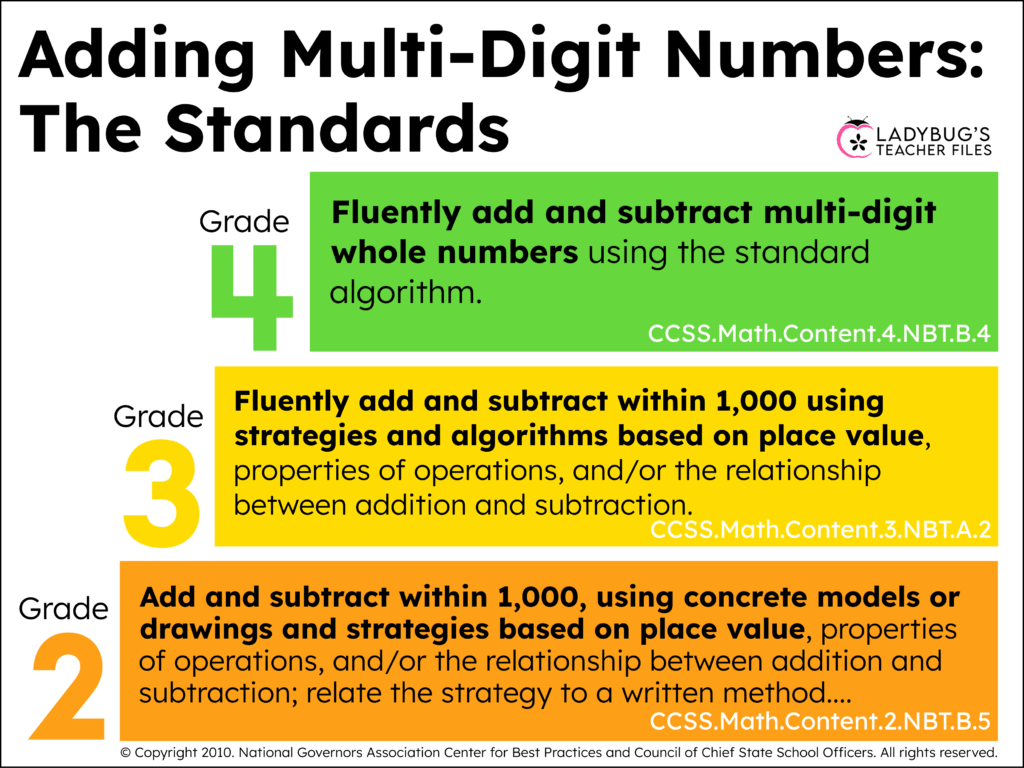
Despite the work in 2nd and 3rd grade, I find that my 4th grade students sometimes need a bit more work with place value as they transition to the standard algorithm.
And partial sums is the perfect bridge to the standard algorithm for addition!
Introduce Partial Sums
As soon as I find my 4th grade students are struggling with the standard algorithm, I shift to partial sums.
If you are new to this strategy, I have another post on how to introduce it here: The Partial Sums Algorithm (a Step-by-Step Teaching Guide)
I always launch partial sums with two-digit numbers (no regrouping just yet!) using place value disks to make the concept concrete:

(click here to see more about introducing place value disks in 2nd, 3rd, and 4th grade)
Place value disks provide a strong visual to help students read and write numbers, from 2nd grade right through upper elementary.
And these disks make it easier to truly understand addition strategies, such as partial sums.
Start with the Ones Place
As I mention in my other post on introducing partial sums, there are many variations on setting up the algorithm. And there really is no one correct way to do so…it’s a matter of adding each part, then combining the partial sums.
I always begin with the ones place, then move to the tens, and hundreds:

This sequence is key in making the bridge to the standard algorithm for 4th grade students.
Scaffold the Steps
Over the years, I’ve learned to provide scaffolds to build student confidence and understanding with the partial sums strategy (along with others!).
I use visual scaffolds to help students line up digits by place value:

And gradually release the scaffolds as students become fluent with the strategy:

It is also helpful scaffold the problems themselves.
We begin with two-digit addition without regrouping, then move to regrouping in a leveled series of practice problems:

As students become increasingly comfortable adding with partial sums, we move to three-digit numbers…and release all the scaffolds:

My ultimate goal is for students to work fluently and add the partial sums below the equation. There is no need to record the addends on the side once they are working with fluency.
Connect the Algorithms
Once my 4th grade students are able to solve partial sums with ease, we make the connection to the standard algorithm.
I set up two of the same addition problems, solving one with partial sums and the other with the standard algorithm:

Then I ask my students one of my favorite questions in math (and one I ask about 1,000 times a week!): what do you notice?
(asking questions like this is a great way to support productive struggle)
Students will often see we are regrouping numbers in both algorithms.
We also note how standard algorithm is more of a shortcut, as it combines the partial sums in one row:

I also love using a highlighter to connect the algorithms. This helps my 4th graders see how the numbers are regrouped in both partial sums and the standard algorithm:

There is nothing more rewarding than seeing that moment of understanding once students connect these algorithms.
And it’s all thanks to partial sums, for creating a powerful bridge to the standard algorithm for addition.
Resource List


Kristen Beakey
I’m an elementary teacher who is driven to design hands-on, scaffolded math lessons and tools for students in 2nd-4th grade. My passion is helping struggling students gain confidence and understanding in math, while saving you time in teaching (because you are busy enough!).
