
Word Form in 2nd Grade: 3 Ideas to Build a Strong Foundation
Share this post:

Ready to take on word form in 2nd grade? Reading and writing numbers within 1,000 is an important concept under the umbrella of Numbers and Operations in Base Ten.
And it is not officially revisited again until 4th grade when students learn to write multi-digit numbers in word form:
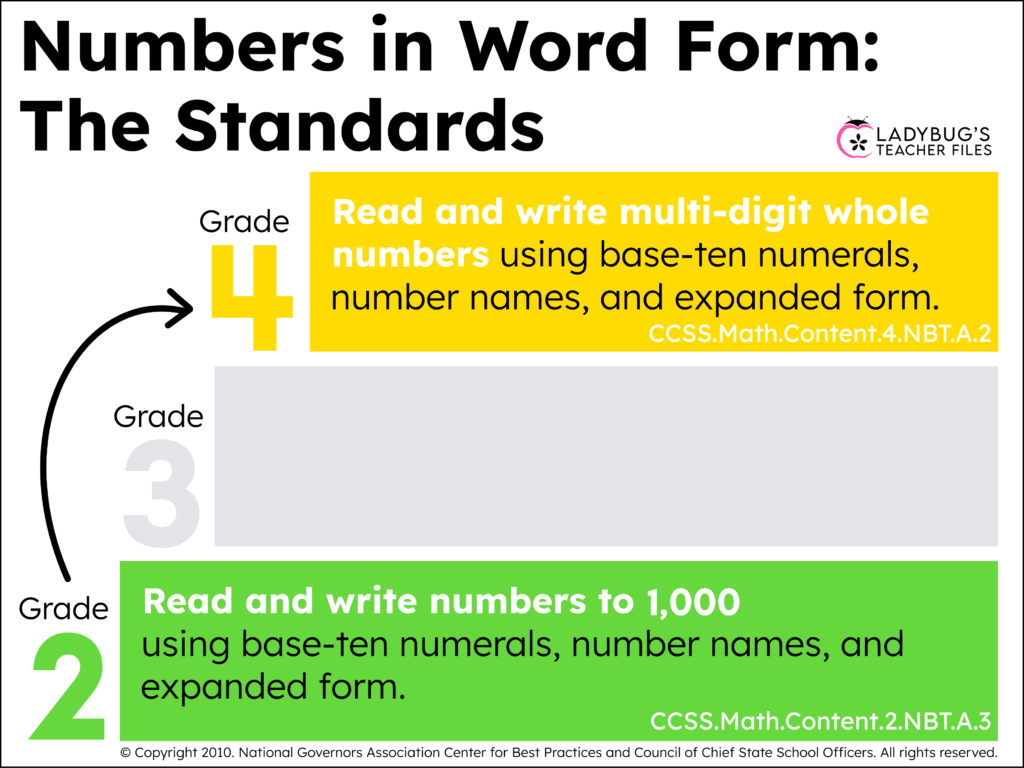
For this reason, it is crucial to build a strong foundation of understanding in 2nd grade that will carry right through 3rd…and ready to build upon in 4th grade.
I love to use these 3 teaching ideas to ensure students can read and write numbers in word form with ease.
Read Numbers with Place Value Disks
As you well know, it is vital to begin with the concrete for any new math concept…and writing numbers in word form in 2nd grade is no exception.
Representing numbers with base ten blocks is always a helpful way to build understanding. But I prefer place value disks for this particular standard.
The very nature of these disks makes it easy to read numbers visually, as each place value is clearly marked.
Place value disks are helpful for representing numbers in expanded form:

Which builds naturally to word form.
Students can easily read “two hundred thirty-six”, looking at the place value disks as they say each part of the number:

And the same is true of writing numbers word form! Place value disks provide a tangible way to see each part of the number that must be written.
But writing those number names themselves can be a bit of a challenge for our 2nd grade learners.
This is when I turn to patterns.
Find Patterns in Number Names
Once my students have begun reading various numbers with place value disks, we take a closer look at number names in word form.
We identify key patterns in these number words, to help students as they write out two-digit and three-digit numbers.
My favorite way to do this is with a simple sorting activity.
(this is a free resource you can grab at the end of this post)
Using number words written on cards, I ask my students to work in small groups to sort the words. We use highlighters to note common features.
This is an open-ended activity and you will see all kinds of great thinking!

Students may notice any of the following:
- words have the same number base
- number words with different patterns (five, fifteen, and fifty)
- the suffixes “teen” and “ty”
As my students sort the number words and share their findings, I record our observations on an anchor chart:

I also use color-coded number word cards.
This helps my students find number words easily when in word form. These cards are part of our interactive place value wall:

As we explore common features of number words, I make sure to share a couple of rules as well.
Which brings us to this next teaching idea…
Share Two Important Rules
As much as I like to use discovery to guide students through new concepts in math, some things just have to be taught as rules.
There are numbers that must include hyphens, so we add that to the anchor chart:

Then we discuss the word “and”.
This may be unpopular thinking, but the word “and” is not part of reading or writing numbers in word form in 2nd grade.
It’s actually not part of numbers in word form for any grade working with whole numbers!
We often hear both adults and students read numbers like “one hundred and thirty-six”.
I know I’ve been guilty of this myself in the past, for many years! And I will tell you in complete honesty, I had to work HARD to break this habit.
Why the fuss over the word “and”?
This words represents a decimal point in math.
You may be thinking 2nd graders don’t work with decimals, it’s not a big deal. But as we talked about in the beginning of this post, we are laying the foundation for future work with numbers in word form.
And it’s actually not too soon to share this information now, even in 2nd grade!
We can use the example of money, keeping it simple:

$1.25 is one dollar and twenty-five cents.
That little “and” identifies the dot that separates the whole number and fractional part of a decimal number.
In 5th grade, the numbers in word form standard continues and students must read and write decimal number names. The word “and” is part of this:

Using these teaching ideas has helped me build a strong foundation for writing numbers in word form in 2nd grade…and I hope they will be of help as you begin this standard!
Please check out the resources below to get started right away. And I always LOVE to hear your thoughts if you’d like to share anything below!
Resource List
- Place Value Disks
- Interactive Place Value Wall
- Number Word Cards (part of the Free Resource Collection below)

Kristen Beakey
I’m an elementary teacher who is driven to design hands-on, scaffolded math lessons and tools for students in 2nd-4th grade. My passion is helping struggling students gain confidence and understanding in math, while saving you time in teaching (because you are busy enough!).
