
Students Stuck in Math? 3 Actionable Ideas to Help with Any Concept
Share this post:

Students stuck in math? Do you ever feel like you are helping them too much?
This may be a familiar scene: a student is completely stuck on a problem, not sure where to even begin and now others are clamoring for support.
So you help just a bit. And a bit more…until it feels like you really told your student how to solve the entire problem.
I know I’ve been guilty of this many times!
And it does not help in the long run, as students learn they can just wait for our support (rather than use strategies to take on any problem on their own).
In reality, getting “stuck” is a natural part of mathematics and we want our students to learn to persevere through any challenge.
And there are ways we can help them do this, without helping too much…
The best part? These supports will work for so many math math concepts, all school year long!
Represent the Problem with Math Manipulatives
If I could shout from the mountaintops, this is the first thing I would say!
Math manipulatives are essential in building conceptual knowledge, starting with the concrete.
And manipulatives are an excellent way to support productive struggle for students stuck in math.
The moment our learners have something tangible to build with, they often become re-engaged in problem solving.
I love to use just a few key manipulatives that work for many concepts throughout the year. We keep these in our math toolkits, so they are ready to go for any problem.
Base Ten Blocks: Base ten blocks are crucial for addition, subtraction, multiplication, division, and decimals…especially when students get stuck solving problems involving new algorithms.
Place Value Disks: Place value disks are easily one of our most-used manipulatives and always a great help when my students are stuck in math. I introduce place value disks early in the year and they are at the ready to support students every day.

Color Tiles: Color tiles are incredible! They are one of the most versatile math tools, supporting everything from addition, multiplication, area and perimeter, prime and composite numbers, fractions on a number line, and more.

Math manipulatives are such an important support in helping students stuck in math…and they can become even more powerful when paired with this next strategy to help our students!
Use (or Create) Math Models
Math models provide another key support when students get stuck in math. Just like the manipulatives shared above, there are several math models that are can be used for so many math concepts throughout the school year.
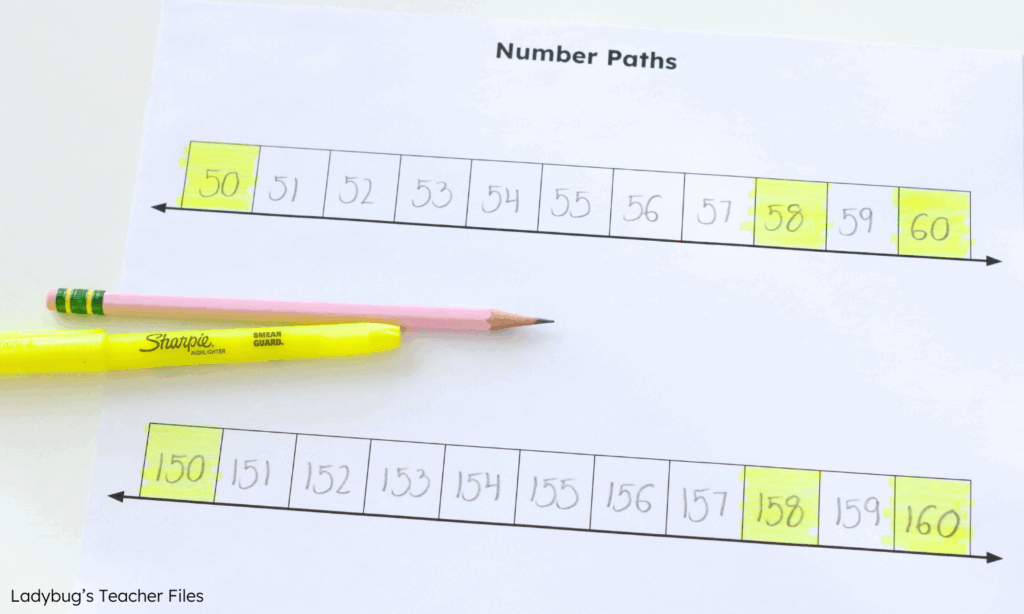
Number Paths: A tool often used in the primary grades, these organized little paths are an excellent support for many concepts in the upper grades as well, including addition, subtraction, patterns, rounding to the nearest 10, and rounding to the nearest 100 (and more!).
Open Number Lines: An ideal math model for tons of concepts, as students can design their own number lines to solve operations with whole numbers, fractions, and decimals:

Bar Models: Another open-ended math model that can be used for partitioning, fractions on a number line, multiplicative comparison, and representing numbers in word problems:

Grid Paper: Ok this isn’t really a model, but a perfect springboard into drawing math models. This paper is ideal for drawing area models, making tables, working with area and perimeter, and lining up digits for those complex algorithms.
And there are so many other math models! I use this set of ready-to-print models in dry erase pockets as a daily support.

But sometimes, even when armed with math manipulatives and models, students still aren’t sure where to start.
This is when I turn to one of my favorite teaching strategies in math…
Ask Guiding Questions
There is such a fine line between supporting a student to get started on a problem and telling them HOW to solve the problem.
Like I said, I’ve definitely fallen into this trap in the past!
Over time, I’ve learned to stop over-helping my students with a simple strategy: ask guiding questions.
A simple, open-ended question can really go the distance without giving away too much of the answer.
Examples of Guiding Questions:
- What do you notice about…?
- Does this problem remind you of another problem we’ve solved?
- Can you create a table to organize the numbers?
Asking these questions can help students find an entry point into the problem, just by guiding their thinking a bit.
These questions have been such a game changer in guiding my students that I’ve created a set of posters and slides with student-centered questions my math learners use as strategies:

I introduce these questions one at a time, then post them as a growing reference as my students learn new ways to tackle problems when they aren’t sure what to do:

I hope these ideas to help students stuck in math are as helpful in your class as they have been in mine!
Do you have any favorite strategies to help your students get unstuck?

Kristen Beakey
I’m an elementary teacher who is driven to design hands-on, scaffolded math lessons and tools for students in 2nd-4th grade. My passion is helping struggling students gain confidence and understanding in math, while saving you time in teaching (because you are busy enough!).
